SCRIBE: A Conceptual Model for Regaining Work Capacity Under Critical Stress

Updated: Feb 5

When critical stress, trauma, traumatic grief, or any adverse event enters leaders' lives, it reduces their capacity to think clearly, make decisions, lead effectively, manage emotions, and be present at work.
Leaders experiencing critical stress often describe feeling foggy, overwhelmed, reactive, exhausted, emotionally numb, shut down, or more that have a direct impact on work productivity. They may notice changes in how they communicate, how they prioritize, or how available they feel to their teams. These changes can be confusing and unsettling, especially for leaders who are accustomed to being decisive and reliable.
This article introduces the SCRIBE Model, a framework I developed to help leaders regain work capacity and steadiness during periods of critical stress or trauma.
The Continuum: What Pushes from Stress to Critical Stress to Trauma
Many experiences can move leaders from routine or manageable everyday stress into critical stress or trauma, including:
Divorce or major relationship disruption
The death of someone deeply loved
Childhood, parental, family, or intimate partner abuse
Accidents or sudden health crises
Other high-impact, destabilizing events
When we are navigating critical stress or trauma, our body often shifts into survival mode, which is seen in physiological changes. I will list some of them below:
Hypothalamic-Pituitary-Adrenal (HPA) Axis Activation: The HPA axis, one of our major neuroendocrine systems, starts flooding our bodies with stress hormones, primarily cortisol and adrenaline. It is to help us escape immediate danger. But continuous critical stress ensures our body has continuously high levels of cortisol and adrenaline, keeping us in a sustained, “get out of danger” mode.
Sympathetic Nervous System Overdrive: Our sympathetic nervous system, designed to protect us by quickly deploying fight, flight, freeze, or appease tactics, is also activated. Continuous critical stress activates it at the slightest sign of danger.
Other Brain Structural Changes: Similarly, with continuous critical stress, our little smoke alarm in the brain, the amygdala, starts to send out warning signals at the slightest whiff of threat, and its shape begins to change. The hippocampus, our filing and storage supervisor, starts to stumble in encoding events and categorizing memories – leaving us with fragmented, disorganized, or hidden memory files.
Nutrition and Digestion: The gut-brain axis also takes a big hit. Continuous release of cortisol and adrenaline can disrupt gut–brain signaling, interfere with digestion, and, over time, deplete essential nutrients.
Trapped Trauma: Trauma can become embodied in us, and it may show up in our sleep cycles, aches and pains, startle response, skin disruptions, or autoimmune disorders.
Our body’s biological attempt to protect us, in leadership and at work, can become our Achilles heel.
Emotions and cognitive functions, such as planning, prioritizing, feeling, emotional regulation, and complex decision-making, become harder under long-term critical stress. It is because the amygdala starts sending out the “red alerts” at the slightest cue, the HPA axis starts flooding the body with cortisol and adrenaline, and the sympathetic nervous system sets into motion for what it has calculated is the best option – fight, flight, just freeze, or start appeasing people.
On a continuum, long-term critical stress can lead to mild to far-reaching declines in leadership or work capacity.
• From clear thinking, leaders might move to a “zoned out” feeling and then to “shut down.”
• Before, they may have easily processed complex data and information and naturally recognized patterns and trends; now, they might find it difficult to process information, recognize patterns, or make assessments.
• Emotionally, because they are team-driven and even charismatic in their leadership, they may find themselves withdrawing, minimizing interactions, and retreating into silence.
Normal work capacity that once felt steady and reliable may now feel exhaustive and overwhelming. Unfortunately, most leaders try to “push through it” with sheer determination and effort. Often this leads to more exhaustion, more reactivity, and sometimes, more self-criticism.
But here is some good news. If the leader's vision had meaning and purpose, the one thing that may not be affected but might actually grow stronger as they overcome this period of critical stress is the vision they hold for their work.
The challenge is how leaders can protect their work, their calling, and the vision they have painstakingly built until now.
The SCRIBE Model: A Framework for Regaining Work Capacity
Statistically, 26% of executive leaders have symptoms of clinical depression compared to 18% of others in the workplace.[1] If we look at leaders in other fields, such as healthcare, legal teams, and business ownership, the numbers for depression, along with anxiety and cPTSD, significantly increase.
For leaders navigating critical stress, the SCRIBE model, a structured, state-sensitive framework, alongside somatic regulation tools, might help leaders manage work without it adversely affected, and regain work capacity. SCRIBE stands for:
S — Situational Scan
C — Context Scan
R — Reframe Findings
I — Identify and Accept
B — Balance by Prioritizing and Managing
E — Engage in Truth
Drawing from Bolman and Deal’s work, each element in SCRIBE is run through four organizational frames: People (HR), Structure (production, services, operations), Vision (personal, company), and Organizational Culture.[2] See attached diagram.
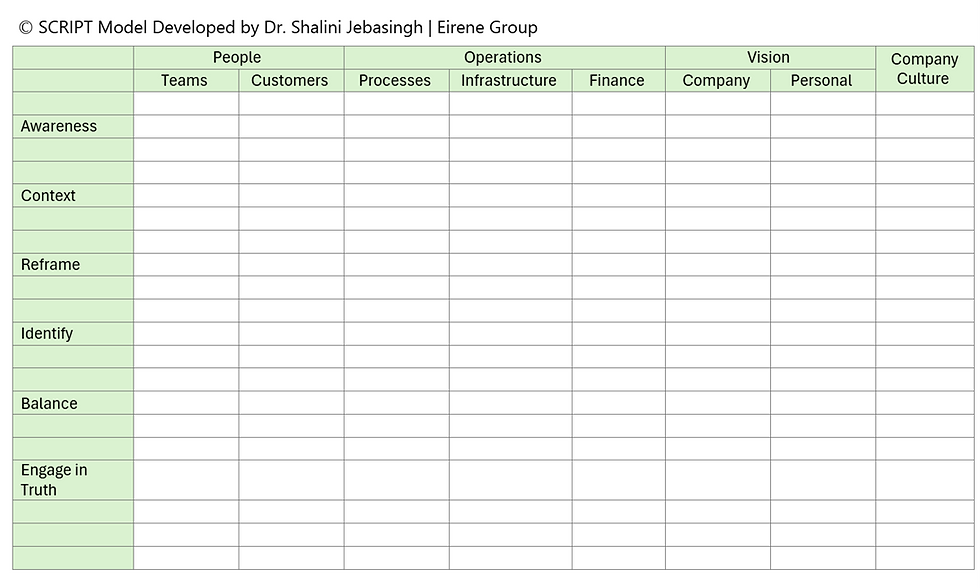
Importantly, with capacity reduction, simply working through one element of the SCRIBE acronym within one organizational frame can begin to restore work capacity. Consistent practice, alongside somatic tools in the early stages, may mitigate adverse work outcomes and begin restoring work capacity.
Below, I will explain the model with an illustration.
Applying the SCRIBE Framework: A Leadership Scenario
Imagine you are the CEO of a mid-size organization. You are generally generous and patient. But now, you notice that you are curt or zoned out. Recently, your trusted colleague, let’s call him Nate, your COO, needed capital investment information from you for software and manufacturing upgrades, which you, the executive team, and key stakeholders in manufacturing had been planning for months. You shut down, freeze Nate and others out, and are unable to communicate in a timely manner with the rest of the team. Unfortunately, this is not a one-time event. You find your productivity being affected more often, and now it is affecting your company’s growth.
We use SCRIBE to start with any event that the leader feels comfortable working with. Say, in this example, our fictional CEO wants to work on “zoning out” and “freezing out” her COO, Nate. I will go through the steps below.
1. Situation Scan:
“I zoned out and froze out Nate.”
Through Organizational Frames:
A. People: It is going to affect his performance – what he can communicate to his reports. Nate is frustrated and annoyed at me.
B. Structure: It is going to affect our manufacturing team – they are out in the cold with no news about the upgrades.
C. Vision: It does not affect our company’s vision. I do think we are continuing to move in the right direction. My personal vision is still aligned.
D. Culture: Gina and John like to leverage their power to influence other teams. They can play politics and get some team members to abandon our core values.
How this helps in regaining capacity: A structured situational scan shifts energy from self-attack or self-judgement to self-awareness and situational awareness.
2. Context Scan:
“My divorce is affecting me far more than I imagined and is taking more time than I anticipated. I am anxious that my daughter will face the same abandonment feelings I had when my parents divorced.”
Through Organizational Frames:
A. People: Nate and I go back a long time. We have proved trustworthy over decades of working together.
B. Structure: The system has been giving trouble for a few months now. Jack is the only one who can fix it and get it working again for a few months at a time.
C. Vision: Company-wide, there are some who have been a little discouraged for the last five months, feeling they are unable to champion our vision. I have not shown up as much as I used to.
D. Culture: We always had a strong culture. And we have not wavered too much from our core values, even in the last five months.
How this helps in regaining capacity: A structured approach to context minimizes effort needed to understand behavior by connecting present reactions to current and past experiences and circumstances.
3. Reframe Findings
“In the current situation and context, how do I ensure the best outcomes for our customers and everyone in the company?”
Through Organizational Frames:
A. People: I need to get things right with Nate. I can’t meet weekly right now, but I can meet every other week. Nate can send a checklist when we don’t meet.
B. Structure: I have to talk to Nate and our manufacturing supervisor before the team gets too frustrated.
C. Vision: Need to talk about vision so our team understands why we do what we do.
D. Culture: Need to talk about culture, get everyone on board with core values.
How this helps in regaining capacity: A structured reframing process can help the leader get started on problem-solving.
4. Identify and Accept:
“What is true in each area of work? Can I see it, hold it, and just breathe without trying to fix them immediately?”
Through Organizational Frames:
A. People: Things are going to be rough between Nate and me, as well as between John, Jack, and me. One of them might quit. It will affect our productivity – and cash flow.
B. Structure: Payroll will have to run a week late. Manufacturing upgrades might have to be pushed to next quarter.
C. Vision: C-suite and directors are aligned. The rest of the team, not so much.
D. Culture: Core values drift is starting to show.
How this helps in regaining capacity: Holding truth, that is, not thinking or feeling about anything else but just thinking and feeling the truth, prevents reactive decisions, promotes the nervous system’s calm, and helps in working through predictive analysis to determine next steps. It is important to recognize this truth in the process: predictive analysis is a projection, not certainty.
5. Balance by Prioritizing and Managing
“What do I see as tasks that are truly and urgently needed for the company’s well-being?”
Through Organizational Frames:
A. People: I need to meet with Nate over a relaxed lunch.
B. Structure: Need to tell the guys that manufacturing upgrades will be next quarter.
C. Vision: Not urgent – plan a company-wide meeting next quarter.
D. Culture: Get Judy to send out core values to everyone.
How this helps in regaining capacity: Prioritizing the top of your list, one or two things you need to do urgently, begins capacity restoration in small steps. It also ensures your work and your team are not adversely affected, thereby positively impacting confidence.
6. Engage in Truth
“How do I walk through the fear, engage without false guilt, and be OK with if I regress?”
Through Organizational Frames:
A. People: Need to be honest with Nate, Gina, John, Jack, and the rest of the team about my availability and responsibilities I am giving them. I need to apologize for being curt and rude.
B. Structure: Jack will bear a huge load with the resets. I have to get him someone who can assist or take over if he needs time off.
C. Vision: I am thankful that most of the company is on board with the vision.
D. Culture: I am thankful culture is not adversely affected as yet. But it can if things keep dragging me down in life.
How this helps in regaining capacity: Truth is foundational for safety. It begins by being truthful within oneself. Truth builds inner strength and trust with others. It reduces fear-driven assumptions and restores relational stability.
Why SCRIBE Works Under Critical Stress
Under critical stress, leaders enter survival mode and act accordingly. Their behavior is driven by the fight, flight, freeze, or appease instinct. It makes leaders tighten control, defer expertise to less equipped team members, delay decision-making, struggle to prioritize, miss deadlines, and more. Unfortunately, this can make workplaces harder for everyone involved and adversely affect work output.
The SCRIBE Model helps leaders do something different: provide directional guidance without the “triggered” outcomes a leader may be experiencing. Brief moments of clear thinking and grounded decision-making can begin restoring work capacity, even before full work capacity recovery.
Access to All
The SCRIBE model is designed for anyone experiencing critical stress to use. However, if leaders are struggling with brain fog or prefer a tactile mode of working through it, working alongside a trustworthy colleague or with a critical stress management coach who understands the neurobiology of stress or trauma might provide better assistance in capacity restoration.
For leaders or team members working on the SCRIBE model by themselves, it is essential that they step aside whenever the process feels overwhelming. Stepping away will help the user regulate and continue.
A Personal Closing: Hope is Alive
From my own experience, I can say this: good leaders, that is, leaders who live their lives in an ethically good manner, examine their motives to ensure they are driven from within by what is good, will move through this period of critical stress without losing their calling or vision. Paradoxically, they may even find their opportunities to serve widening and deepening in surprising ways.
With the right tools and support, their work and leadership do not have to be disproportionately affected as they navigate long, drawn-out critical stress, trauma, grief, or other adversities.
My hope is that the © SCRIBE Model enables leaders to lead with integrity, even in difficult seasons, and helps them regain capacity and thrive again.
I wish you the very best in life and in work.
Dr. Shalini Jebasingh is a trauma-informed Critical Stress Management Coach and Values-Based Organizational Trainer, the Founder of Eirene Group and Bible at Work, and the developer of the SCRIBE Framework and the Love in Leadership Assessment.
Explore: SCRIBE Framework | Love in Leadership Assessment | Bible at Work | To invite Dr. Shalini Jebasingh to speak at a conference or to your team at work, email hello@eirene-group.com.
[2] Bolman, L. G., & Deal, T. E. (2021). Reframing organizations: Artistry, choice, and leadership (7th ed.) Jossey-Bass.

Comments